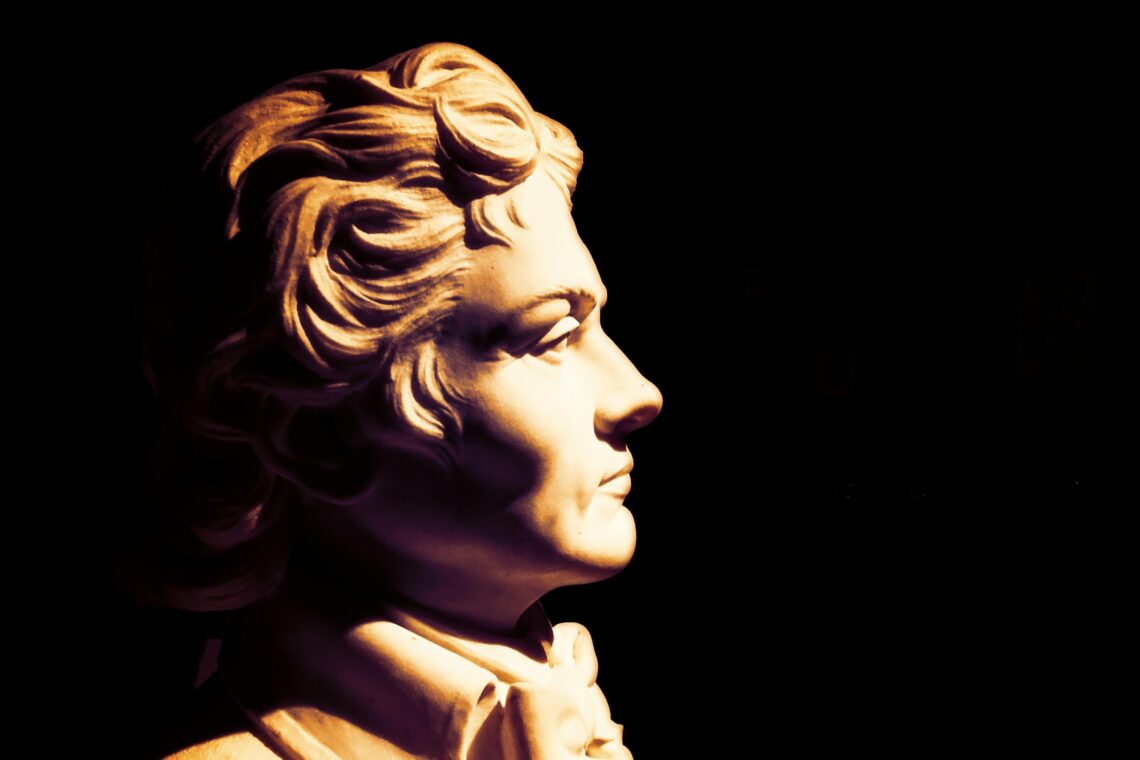
by Dale Scherfling
I. Beethoven’s Fifth at Joe’s Place
Danny slid onto his usual stool at the end of the bar, the one with duct tape holding the vinyl together like a field dressing. Joe was already pouring before Danny’s ass hit the seat.
“Whiskey neat,” Joe said, setting it down. “Like you’d order anything else.”
“Consistency is the hobgoblin of small minds,” Danny said, lifting the glass. “Or genius. I forget which Emerson meant.”
“Pretty sure he meant you should try something different once in a while.” Joe wiped the bar with a rag that had seen cleaner days and better decades. “You writing today or just thinking about writing?”
“Same thing.” Danny took a sip and let it sit on his tongue. “Hey. You know what a fifth of whiskey would’ve cost in 1800?”
Joe squinted. “This one of those things I’m gonna regret answering?”
“Five cents. Maybe less. They didn’t call it a fifth back then. Probably just ‘whiskey.’”
“That’s oddly specific for a Tuesday.”
“Fell down a rabbit hole. Looking up Beethoven. Somehow ended up reading about frontier liquor prices. They paid ministers in whiskey, Joe. Can you imagine? ‘Bless you, my child. That’ll be three gallons.’”
Joe snorted. “I’ve seen worse churches.”
The door jangled and three girls came in trailing cold air and perfume—expensive leather bags, artfully distressed denim that cost more than Danny’s rent. They took the corner booth like it had been reserved for them by birthright. The blonde with the nose ring caught Danny’s eye and smiled like she’d just found something authentic.
“Your fan club’s back,” Joe muttered.
“Patrons of the arts,” Danny corrected.
The blonde—Madison, or Madeline, something with money in it—drifted over and leaned against the bar in a pose she’d practiced in mirrors that didn’t crack.
“Danny! We were hoping you’d be here. Sienna’s writing a paper on Kerouac and we told her you’re basically a beat poet.”
“I’m really not.”
“So modest.” She tilted her head. “Let me buy you a drink?”
Danny lifted his still-full glass.
“Well, we’re getting a bottle of wine. The expensive one,” she added, as if Joe awarded medals for that. “You should come sit with us. Bring your brooding artist energy.”
“Tempting,” Danny said, “but Joe and I are in the middle of an important discussion about Beethoven.”
Her eyes widened. Wrong move.
“Oh my God, I love Beethoven. The Ninth Symphony? ‘Ode to Joy’? Literally life-changing.”
“We’re talking about the Fifth,” Danny said, straight-faced.
She hesitated. “Is that the one that goes da-da-da-DUM?”
“That’s the one. Cost about five cents in 1800. Wouldn’t have broke him.”
She blinked, the gears visibly skipping.
“Danny’s doing a bit,” Joe said. “Music theory. Real dry.”
“Oh! Right.” She laughed, relieved. “You guys are so weird. Okay, we’ll be over there if you want to, like, educate us.” She hip-checked him lightly on the way back, leaving behind perfume and expectation.
Joe poured himself a short one. “You’re going to hell.”
“For what? I just shared historical context.”
“You know what you did.”
Danny smiled but didn’t answer. He watched the booth for a moment—the three of them already leaning close, already constructing the story of the night.
Marcus came in a few minutes later, paint under his fingernails, jacket splattered like a casualty of something expressive. He dropped onto the stool beside Danny. Joe had his beer waiting.
“The trust fund table’s back,” Marcus observed.
“Indeed.”
“You hitting that?”
“The blonde’s decided I’m her semester project.”
Marcus grinned. “The redhead asked about my ‘creative process.’ I told her I mostly get high and ruin canvases until something survives.”
“What’d she say?”
“Asked if she could watch sometime.”
Joe leaned on the bar. “You two are real bitter for guys who are gonna be three drinks deep on their dime by nine.”
“We contain multitudes,” Danny said.
“You contain bullshit.”
“That too.”
Madison reappeared with a twenty folded neatly between two fingers. “Another round for Danny and his friends? Whatever they want. And tell them to come sit with us.”
Joe took the twenty without comment.
“That’s generous,” Danny said. “We’ll be right over. Just finishing up a discussion about fiscal policy in the Napoleonic era.”
Her eyes went wide again. “Oh, wow. Okay!”
She floated back to the booth.
Marcus shook his head. “Napoleonic?”
“I like to keep them off balance.”
“You’re an asshole.”
“These things can both be true.”
Joe set down three fresh drinks. “Beethoven’s Fifth—that opening? Da-da-da-DUM. Supposedly that’s fate knocking at the door.”
“I know.”
“You think that’s what this is?” Joe gestured around them—the bar, the booth, the twenty already half-spent in his head. “Fate knocking?”
Danny looked at his whiskey, amber in the low light. Five cents in 1800. Ten bucks now. Madison’s twenty covering them all with a little left for Joe’s jar.
“You gonna feel bad about it?” Marcus asked.
Danny didn’t answer right away.
For a moment—longer than he meant to—he pictured himself older, still on this stool, still explaining things to people who forgot him by morning. Still confusing irony with depth. Beethoven deaf. Broke. Immortal.
He swallowed the rest of his drink.
“Ask me in the morning,” he said. Then, after a beat: “Nah. Fate knocks. This is just Tuesday.”
“Deep,” Marcus said. “You should write that down.”
“Fuck off.”
Joe shook his head. “You already got the title, don’t you?”
Danny slid off the stool. “‘Beethoven’s Fifth at Joe’s Place.’”
“Jesus Christ.”
“What? It’s clean.”
Marcus grabbed his beer and followed. “Brave men.”
They crossed to the booth. The girls looked up at them with wine-flushed faces and bright expectation, like they’d ordered something rare and were waiting for it to arrive.
Madison scooted over. “So,” she said, smiling up at him. “Tell us about Beethoven.”
Danny caught Joe’s eye across the bar. The bartender shook his head, but he was grinning.
Danny slid into the booth.
“Well,” he said, folding his hands like a lecturer about to begin, “let me tell you about the Fifth.”
Somewhere in Vienna, Beethoven was still dead and famous.
Danny was alive.
And still performing.
II. Beethoven’s Ninth at County General
The fluorescent lights at County General hummed one note, 24/7 — the world’s most depressing organ drone. Danny had been listening to it for three days, watching his father sleep between the beeping and the footsteps and the distant sounds of people having worse nights than this one.
Marcus showed up around eight with coffee that tasted like it had been filtered through someone’s gym sock.
“You look like shit,” Marcus said, dropping into the plastic chair that had become his assigned seat.
“Thanks. You brought your A-game.”
“How is he?”
Danny looked at his father — smaller in the hospital bed, like illness had compressed him. The old man’s breathing was steady but labored, a metronome running just slightly off tempo.
“Stable. Whatever that means. Doctor says hours, days, weeks. Very helpful.”
Marcus sipped the coffee and didn’t pretend it was good. “You call your sister?”
“She’s flying in tomorrow. Chicago.”
“You eat anything?”
“There’s a vending machine.”
“That’s not eating. That’s punishing yourself.”
Danny didn’t answer. Through the window he could see the parking lot — the same cars in different spaces, people coming and going like the world hadn’t paused just because his father was dying in room 347.
His phone buzzed.
A text from Madison: thinking of you. let me know if you need anything. here for you ❤️❤️❤️
He’d texted her once, three days ago. Dad in hospital. Won’t make dinner.
Apparently that had been interpreted as an invitation to ongoing concern.
“The blonde?” Marcus asked, reading his face.
“Yep.”
“You gonna tell her to back off?”
“What’s the point? She means well.” Danny set the phone face-down. “She sent flowers yesterday. To the hospital. With a card that said ‘Get well soon!’ Like he’s got the flu.”
Marcus made a sound that might’ve been a laugh. “Jesus.”
“I didn’t have the heart to correct her.”
“Since when do you have a heart?”
“Apparently since Tuesday.”
The old man stirred, eyes fluttering but not opening. Danny leaned forward instinctively, then eased back when nothing else happened.
Just rehearsal for the main event.
“You remember that night at Joe’s?” Danny said. “The Beethoven thing?”
“Which one? You do that bit every few weeks.”
“The first one. The Fifth Symphony joke. Five-cent whiskey.”
Marcus nodded. “The redhead asked if she could watch me paint.”
“Whatever happened with that?”
“She showed up once. Took three hundred Instagram photos. Never came back.” He shrugged. “You hit it?”
“Once. Maybe twice. I honestly don’t remember.”
“Poetic.”
They sat in silence. The fluorescent drone continued. A nurse came in, checked vitals, smiled professionally, left. The machinery of keeping people alive ground on with bureaucratic efficiency.
“He ever talk to you?” Danny asked. “About this stuff?”
“Your dad? Sure. Sometimes.”
“What’d he say?”
Marcus took his time answering, which meant he was thinking instead of performing.
“He said you were a good writer. Said you were wasting it on being clever when you could be being honest.”
Danny felt something shift inside his chest — not pain exactly. Recognition.
“When did he tell you that?”
“Last year. Joe’s. You were in the bathroom. I asked if he worried about you.”
“And?”
“He said no. Said you’d figure it out eventually.” Marcus met his eyes. “Said the scared ones usually do.”
“Scared of what?”
“Didn’t specify. I assumed life. The real stuff.”
The old man’s breathing hitched for a second, then settled back into its uneven rhythm. His eyelids twitched like he was dreaming.
Danny wondered what you dream about when you’re dying. Something profound? Or just your teeth falling out?
His phone buzzed again.
Joe: Marcus says you’re at County. I’m closing early. Be there around 10.
Danny typed back: You don’t have to.
The reply came fast.
Shut up. You want anything?
Whiskey neat.
Funny. I’ll bring sandwiches.
Marcus watched him. “You gonna cry?”
“Fuck off.”
“Just checking. You’ve been holding it together pretty good. Thought maybe you were due.”
Danny stared at the floor.
“I don’t know what I’m supposed to feel.”
And that was the most honest thing he’d said all week.
“He’s dying. I know that. I can see it. But I keep waiting for the big moment. The revelation. The thing that makes it make sense.”
“Maybe there isn’t one.”
“That’s worse.”
“Yeah.”
The old man’s eyes opened. Just a crack — but open. He looked at Danny with something that might’ve been recognition.
“Hey, Dad.”
The old man’s lips moved. Danny leaned closer.
“…water.”
Danny grabbed the cup with the bent straw and held it steady while his father drank. The old man’s hand came up, shaking, and wrapped around Danny’s wrist. The grip was weak.
But it was there.
“You’re okay,” Danny said, not knowing if it was true or just what you said.
His father’s grip tightened, barely.
“Did my best,” he whispered.
“I know.”
“You do yours.”
“I’m trying.”
The old man’s eyes closed. The grip loosened. His breathing evened out again. Back to sleep. Or something like it.
Danny sat back down. His hands were shaking.
Marcus didn’t say anything. He just sat there, drinking terrible coffee, being present in the only way that mattered.
Joe showed up at ten-fifteen with a deli bag and a thermos of actual coffee. He took one look at Danny and set everything on the rolling tray.
“He wake up?” Joe asked.
“For a minute.”
“Say anything?”
“Did my best. You do yours.”
Joe nodded like that explained everything. Maybe it did.
They ate sandwiches. They didn’t talk much. Outside, the parking lot emptied and filled again with the night shift. The fluorescent drone never stopped. The machines kept their steady rhythm.
Around midnight, Marcus pulled out his phone.
Beethoven’s Ninth. The choral part. “Ode to Joy.”
“Really?” Danny said.
“Madison said it was life-changing,” Marcus said, straight-faced. “Thought we should give it a shot.”
Joe snorted.
Something in Danny gave way — not breaking, just opening. He started laughing. Not the clever bar laugh. Not the ironic one.
Something tired and real and grateful.
His father slept. The music played softly through the phone speaker. Joe poured coffee into three paper cups.
“To doing your best,” Joe said, raising his cup.
They drank.
Somewhere in Vienna, Beethoven was still dead and famous. Danny was alive and uncertain. The whiskey was good. The coffee was better.
And for once, he wasn’t waiting for the clever ending.
He was just there.
Dale Scherfling is a fulltime writer, a former newspaper editor and retired U.S. Navy photojournalist. His work has been accepted by The Monterey Poetry Review, San Diego Poetry Annual, Chiron Review, Mangrove Review, Letters Journal, The Blotter Magazine, 25:05 Magazine, Discretionary Love, Writing Teacher, Third Act Magazine, Yellow Mama, Close to the Bone, Flash Phantom, Dispatches Magazine, Five on the Fifth and Oddball Magazine.
Photo by Warren Carr: https://www.pexels.com/photo/close-up-shot-of-a-statue-7120207/

