by Julian Walker
As we were going through the Da’s things – so few, he did not acquire objects, he borrowed books from the library and listened to what the radio offered – we found a notebook, dark red with a black cloth-covered spine. There were a few dozen started poems, short, unedited and careful. Sentimental perhaps, the work of a mind that received the world with a rare level of care and depth but struggled to match this with tutored expression. Quiet and pointed observation – the curve of the back end of a horse, the noise of a bus drowning other sounds. Each piece on a separate page, gently written in the blue pencil he always used.
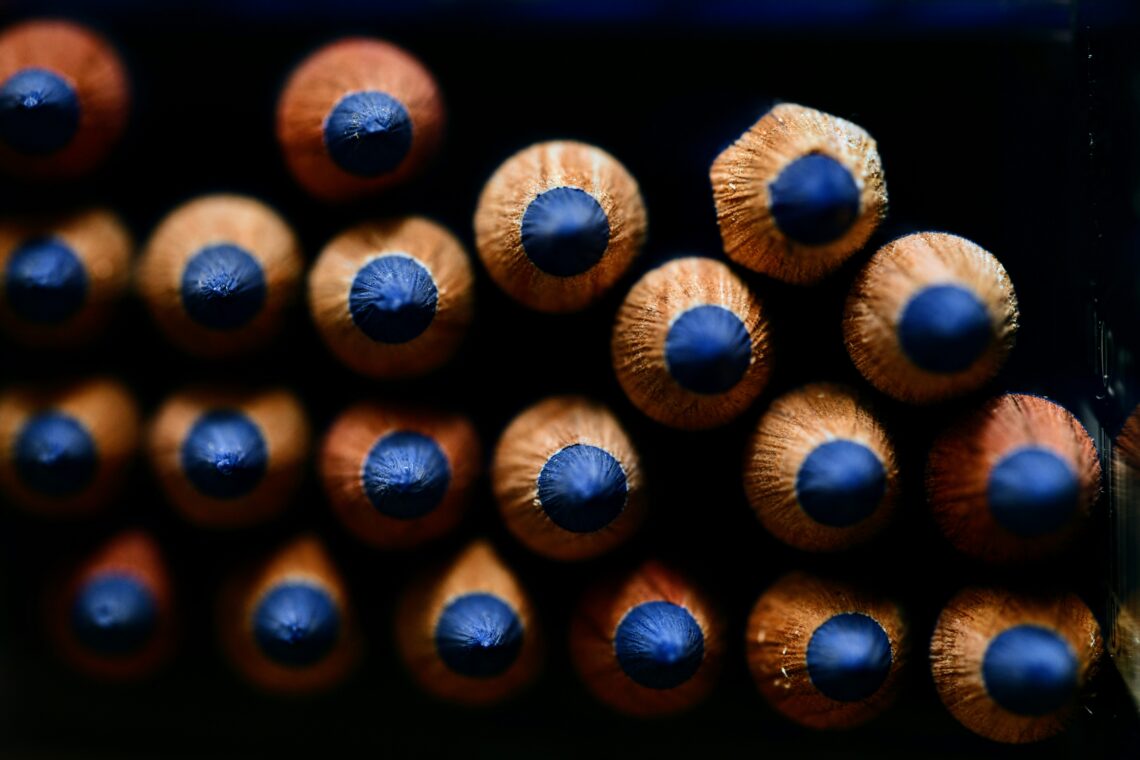
The blue pencils were always there. When one was worn and sharpened down to a few inches a new long one would appear. Each pencil had ‘Government Issue’ written along the side.
– Da, aren’t blue pencils for the government? I once asked him. – Did you liberate them?
– I don’t know what you’re suggesting my girl, he replied. – Your grandfather bought a box of them in a sale. He thought he was buying mixed stationery.
Later I asked how many there were, and would we ever see the end of them.
– I doubt it. 144 boxes, each of them with twelve pencils. I’d say there’s enough for three or four generations. Though you don’t use them. Or your Ma with her ballpoint pens. And yous with your laptops and your blackcurrants.
He did this deliberately, holding to himself whether it was a mistake or him selectively mocking new technology. He tentatively used emails at work, and once asked me about buying a book from Amazon, a book the librarian said was not available.
– It will take a long time, all that way, he said.
In our house shopping lists were in ballpoint, lists of jobs for the garden in blue pencil. Christmas cards were in ballpoint, notes for pending house maintenance tasks in blue pencil. Letters to school were in ballpoint, deadlines for administrative tasks – tax returns, return of library books – were in blue pencil on the calendar. The blue poems in the notebook were neither lists, tasks nor administration, though they carried echoes of all of them.
The horse’s rump, outside
Goes out, then in between the biceps femoris
And the semitendinosus
Then turns out and flat and in to the tail, sharp in
There before the tail
I had no idea he was interested in horse anatomy. I never heard him talk about it. It was a list of observed facts. He was collecting information, like the boy on the bus who watched and waited and ran past and took my phone as I was turning away, a silent movie, with my wordless attempt to shout and my impotence and sitting facing the window because I could not look at where it had happened. On the pavement outside he looked up at me and smiled and let the phone slip from his hand to the pavement. It was old, and of no value.
A bus whether you are inside or out makes
More noise than expected. I am
Distracted by it, unable to
Remember the list of things I
Was trying to remember. The
Noise drives over my thinking. Not one
Thing.
The blue lettering, almost like from a crayon, blurred at the edges, looked always old. I could not tell whether it had been done when he was twenty or sixty. I could not tell if the arrangement of words, stopping before the end of the line, indicated a poem or just a desire for a little space, enough to see a bit of sky between things. The application of capital letters, at random through the sentences, but at the beginnings of lines, might be carelessness, a memory of the conventions of poetry, or a tussle with the rules of punctuation. Gentle acts combining resistance and governance, like bending one branch of an apple tree away from another.
He did not bend me. Because we did not argue. He listed facts as he saw them, so there were confrontations, but not arguments, no attempts by each to sway the other. He is not good enough for you. His hair is a bit long. I don’t know what you see in this one. I had no reasons. I did not like them because they were good, for their hair. I had no points to make, other than that they were there, I fancied them, they smelled of themselves, they kissed well, they knew when and where and how to touch, they were tender, funny, outrageous, naughty, thoughtful. A list, the administrative business of teenage relationships, tasks carried out, but not in a way my father would see. And at last the exchange that stopped and restarted time.
– I can’t imagine what he does for you.
– He fucks me and I like it.
The slightest of frowns and the end to every, the only, the eternal argument, the words shouting for the blue pencil, the words hard and sharp, but the blue pencil both soft and clear.
– Govern your tongue, he said, and turned away.
I look at how the words have slipped gently to the pages of the notebook, no signs of pressure on the back. Blue, the edges blurring with the white, like receding into the distance, between the branches of the apple-trees at the end of the garden.

Julian Walker is 71, and lives in London. After a career in art and teaching, which included publishing several books on the history of the English Language, he started writing fiction a few years ago. His short fiction is mostly published under the imprint StuffLikeThatbooks, which he manages. He has recently ventured into writing drama.
Photo by shraga kopstein on Unsplash

