by Emily Hay
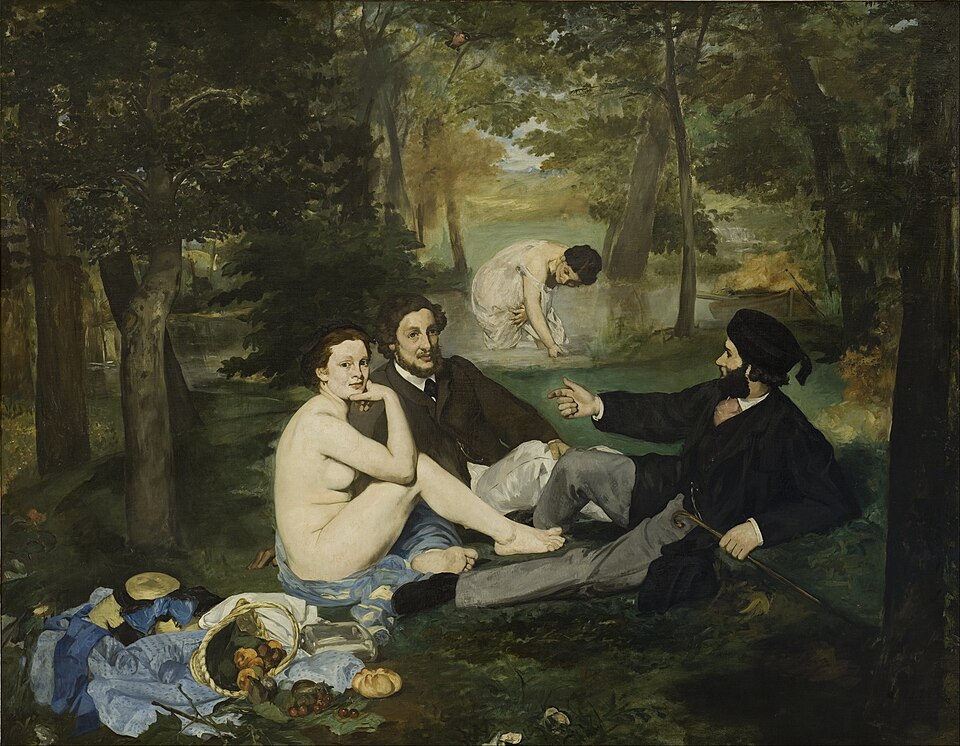
She woke into a memory. They were in a theatre, in the dark, and the stage had become a painting. The actors were completely still as the curtain was raised. The greenery was lush and real. Manet’s painting, Le Déjeuner sur l’Herbe was recreated, even down to the white tones in the flesh of the naked woman front-stage.
It was a play inside the painting. The actors were eating their picnic, curled into each other. The woman towards the rear of the stage dipped herself into the water again, draped in a light slip – was it really so transparent in the painting? The water may or may not have been real, but there was a splash. It was a hot afternoon under trees by the Seine, and Gwen wondered whether she was feeling the heat from the sun, or from the stage lights, or from being wrapped up too closely in her pyjamas and duvet.
The painting had been attacked at the time. What was more shocking – that the women were undressed or the men so overdressed, in their dark, sweaty suits? As if they were dressed for the studio, and the models were undressed for the studio.
Gwen remembered that in Monet’s riposte to Manet, everyone got their clothes back on and relished the picnic rather than staring out at the prurient viewer.
She emerged from this thought and no longer knew who or where she was.
She looked up, puzzled, at the woman who had opened the door to the room. “Gwen!” the woman said, pulling the curtains aside just enough for the light to come in from the garden. “It’s a beautiful day. And we need to get you up out of bed and into your chair.”
Now Gwen could see the paintings hanging on the bedroom wall.
The shapes in the picture seemed disjointed, but she could remember painting that still life. In the centre of the picture was a stoneware jar. The concentration it had taken to paint the reflection on the glaze just right. The sliced pumpkin that had become more and more overripe, and collapsed in on itself, as she painted the different layers of orange. She could remember the smell.
There was an overripe smell in the room now. She and the woman were ignoring it.
Instead the woman unwrapped her from the bedding and the pyjamas and the pads that had been making her so hot. In a routine that was automatic, the woman tenderly wiped her clean with baby wipes. Gwen remembered what to do as the woman spoke. She raised her body, pushing from her shoulders and feet, lifting her torso off the bed. It was like changing a baby’s nappy, but instead she was the baby.
It was a calm time of day. The woman spoke soothingly. The words slipped through Gwen’s mind. But occasionally “Just do that for me, darlin’” and she did. The bed she was on was like a hospital bed. She had given birth in a bed like this, to her first child. Blood everywhere. “Am I bleeding?”
“No, Gwen. Everything’s just fine. I am going to give you a lovely wash with this warm water, all soapy. You just lie back.”
She had given birth in the early hours in that bleak hospital in Whitechapel. The anaesthetist had gone home to snatch some sleep or was managing another woman. A white, bare room, no pain relief, time extending. Afterwards, she had been so exhausted, she had lain there bleeding onto the white, plastic bed. A kind woman, much kinder than the midwives, had come in. When she had asked, the woman had said she was from Jamaica. All the midwives were white then. How long ago was this? No sense any more of time. Blood, shit, so the woman who comes to you is from a different country and is black.
She is so gentle. I am naked and being washed again, Gwen thinks, but not in words. Words drift. Pictures stay. She sees her belly, which is large. As large as when she gave birth. “No baby.”
“Your daughter is grown, darlin.’ They’s all grown up and you have grandchildren. I’ve seen them.”
She had lain completely naked on that hospital bed; had been so weak she could not lift herself when the woman washed her free of blood and sweat. The woman had rinsed her, and applied gentle oils, expecting Gwen to do nothing, not to lift a finger. Had turned her as she might turn a small child. Had spoken to her all the time, calmly. Had her own mother ever done that for her? It seemed difficult to believe.
The naked body was so different to the one clothed.
When she started life-drawing classes at art school, aged sixteen, she sat at the front, with her friend Ann. That way, she didn’t have to look at the men looking at the model. She could simply sit, and share charcoal and pencils with Ann, and work out lines and curves and be completely absorbed. For the first time that year, she was praised. She had been no good at lettering, no good at drawing infinite perspectives of mills and streets when they went out drawing in Leeds. At the end of the year, she came top of the class in life-drawing.
Now she was naked again. Just her and her carer in the room. The woman wiping curves painstakingly with a flannel and warm water.
Nakedness could be innocent. The boundaries between dressed and undressed, perhaps were not.
She and Joe had lain on the beach in the sun – sun so hot, sand so hot that they had burned. There was scarcely any shade, just the tent, which was stifling, and it was an island. It was an island nudist beach. The top of her leg went first brown then scabbed in the scorching sun. Jumping into the Mediterranean made no difference.
A boat across the straits to that island had seemed like a dream. But they had burnt. A man came round to tell them to take their clothes back off. No liberty. No shade.
The doctors had cut a lump out of her, where so long ago her leg had burned.
Now someone else had walked into the room. Someone who she knew must be her own daughter. Or was it her sister? The woman and the carer were examining her leg.
“It’s healed well,” her daughter/sister said. “Not even any scarring.”
“You got burnt too,” Gwen said.
“No, Mum, you covered me up well. This is where you got burnt when you were in France. You told me.”
Manet moved nakedness outdoors and into the present, and that was shocking. Gwen’s mind drifted back to her thoughts. It was more shocking if some were dressed and some not? But not indoors where, if some were dressed and the model was not, it was entirely expected. Not shocking because it was education or art. And the model was still.
Why was a model motionless OK, but a model moving not OK? She was in the memory of a theatre again, a different theatre, earlier. Joe had taken her there because it was supposed to be shocking, or avant garde. Westminster Council had given it publicity by threatening to shut it down unless the women, always women, completely naked, were completely still. As still as models or statues. She hoped they were warm under the lights. Sometimes, the model in art school got goosebumps – she could see them from her front-row chair. When the model’s toes started going blue, the teacher had to call for a cigarette break.
She had sat in her seat in the theatre and drawn in the half-dark. She was always drawing then, everything, people clothed and unclothed, and the models on the stage. Perhaps later her drawing would have been part of the performance, proof that this was art, an installation or a happening. Selling bricks or jokes or concepts and freezing them for money.
She was chilly now. But the familiar woman was rubbing her dry, and had wrapped her in the towel, and moved her to the commode. She was drying in between Gwen’s toes, and murmuring words that Gwen could not hear because she was looking down. And then applying lotions. “So you don’t dry out and shrivel up!”
Washing was innocent here. Not like when Joe had invited her round to his flat for a bath – the luxury of a flat with a bath and hot running water. Joe painted her picture when she was in the bath. Then Joe took his clothes off because he needed a dip and that was the last of the hot water. They used up two shillings on the gas, topping up the bath again and again, with the hot water geyser in the kitchen flaming, the bath steamy, as they kept away the cold.
She remembered they wrapped themselves together in the only big towel and kissed. The warmest place after that was Joe’s narrow bed.
Emily Hay is a lifetime Londoner, a former civil servant and carer, now City Lit student and community volunteer. Her poetry and prose has been published by Lancaster Litfest; Morphrog; Poetry Bus; Coffee House poetry magazine; Apricot Press; Riggwelter Press; Gay Authors Workshop; Vernacular Journal and Mslexia Salon. Shortlisted for the Creative Future Writers’ Awards 2025 and 2026.
Featured image https://en.wikipedia.org/wiki/Le_D%C3%A9jeuner_sur_l%27herbe

