by Leon Prescod
All at once nothing was happening. Over the past three days Paige had grown more distressed by the hour. Now, his wife’s steady breathing soothed his thoughts. Lennox was usually anxious about something. A late-night talk radio host, his introspective style was sometimes referred to as new masculinity, which made him anxious.
The printout of their birthing plan, discarded with the second batch of takeaway food cartons, said ‘No Epidural’ across the top.
“Better?” said Lennox.
Paige half opened an eye. Her smile broadened.
“Everyone should have an epidural,” she said, sinking back into the relief of anaesthesia.
*
On the first day, the heart rate monitor had stopped pulsing.
“What’s wrong?” said Paige.
“One minute, my darling.” A small woman in a blue uniform checked wires and connections.
“I’m not your darling.”
The woman pressed buttons and pursed her lips.
“Fucking hell, are you an idiot? Can we get someone who knows what they’re doing?”
The woman adjusted the belt around Paige’s abdomen.
“What are you doing? Get a doctor.” Paige turned to Lennox. “You go.”
The woman continued to manoeuvre the belt.
“Why are you fucking ignoring me?”
The machine resumed its steady bleeping.
“There,” the woman said. “You have been wriggling too much, that’s all.”
Lennox followed the woman into the corridor.
“I’m so sorry. She’s scared.”
A raised eyebrow.
“I know scared. This,” gesturing towards the room, “is wickedness.”
He noticed a sign outlining the policy on abuse, harassment and aggression. His wife had hit four out of five bullet points of unacceptable behaviour.
*
Paige snatched her hand away when he tried to take it.
“How are you doing?”
“If she comes back, I’m pulling the alarm.”
“She’s doing her best.”
“It’s not good enough. Why is no one from this country?”
Five out of five.
“You don’t mean that.”
“Don’t tell me what I mean.”
The window overlooked a prison next door. A bus rumbled past, and Lennox followed its path in his mind, up towards the cemetery and crematorium on the brow of the hill.
*
He watched them take her insides and place them outside. A circle of people in robes, heads covered, masks over their faces, probed his wife’s abdomen through an opening they had made in her body. She shook like an animal. In the final seconds before parenthood shifted from possibility to present, Lennox discovered he could see both past and future in Paige’s internal organs: his mother flinching as his father reached for something behind her head; Paige graduating wearing lycra shorts beneath her gown; their second child texting to say he had been given a date for his top surgery; grandchildren at his bedside and him wanting to speak, but his throat was blocked and thoughts would not align.
*
He cut the cord. Someone took their son aside for weighing and inspection, asked Lennox to help with the first nappy, then swaddled the infant and handed him to the giddy father. When he realised that behind the mask was the woman who called Paige wicked, he wondered about witchcraft and curses.
*
Years later, in the same hospital but with no view of the prison, their son lay unconscious with two doctors bent over him. They had been hosting a sixteenth birthday party for the boy’s friend, because they had the big house. The radio show had morphed into a podcast, and Lennox was a minor celebrity. At the party, their son collapsed. His friends swore there were no drugs or alcohol. He simply dropped to the floor.
The doctors spoke quietly to each other, then the taller of the two addressed the parents. Lennox could sense that Paige wanted him to take the lead, but he was having trouble focusing on what the man said. The doctors were confused, and that was making him confused too. He wanted to avoid upsetting anyone by requesting clarity. When Paige spoke, her voice was even, calm. This was how she had raised their children, gracefully.
“So you want to keep him like this for a while before you do anything else.”
“That’s right.”
The doctors, Lennox noticed, were not offering reassurance. Nor had they said ‘induced coma’, but he had seen enough medical dramas.
“How long?” said Paige.
“Not long.”
“How long is not long?”
“We can’t tell yet, I’m afraid.”
In the silence, Lennox noticed the sign on the wall. The behaviour policy had hardly changed in sixteen years. The smaller doctor followed his gaze.
“I’d burn that if I could,” he said.
For the first time since arriving at the hospital, Lennox felt he understood something.
“You’d like to abuse, harass and be aggressive to your patients.”
“Not exactly, although to be honest, quite often it’s what they need.”
“Doesn’t seem very doctorly.”
Paige sighed.
“I’m sure you have to put up with all sorts,” she said.
“A hundred thousand attacks each year,” said the small doctor, “those that get recorded.”
Lennox plumbed his memory for statistics from a recent interview with a psychologist on the podcast, something about the circularity of violent behaviour. Paige looked at him with begging eyes.
“I’m going to get coffee,” he said. “Anybody?”
In the ward corridor, a man hung off the side of a trolley bed trying to pull himself back up, while a nurse in latex gloves tore strips off an enormous roll of blue tissue paper and scooped vomit from the floor; a toddler crashed a fire truck repeatedly into the foot of a chair on which a woman wearing earbuds sobbed into her phone; there was a stink of excrement from somewhere.
The coffee machine was beyond the nurses’ station. On his way there, he heard a snatch of conversation.
“I nearly said, ‘I’m glad your mum’s dead. She was a stinky old cunt and nobody liked her.’ I swear, I was this close.”
On his way back, two different nurses.
“I thought, ‘You can put lipstick on a pig, mate, but you can’t hide that massive cock.’”
The tall doctor was gone when Lennox returned. The small one was issuing instructions to the nurse who was glad someone’s mother was dead. He turned when Lennox entered.
“Ah, the people’s champion.” He smiled thinly.
Lennox wondered whether the man knew his work. Often strangers had opinions about him based on the podcast, felt they were friends, or enemies. It happened more frequently since the pandemic. He passed a cup to Paige and she gave his hand a squeeze whose intent he failed to translate.
“I’m just curious, I suppose,” said Lennox, “how it’s possible to provide good care for people if you don’t respect them. Doesn’t it get in the way of helping, if what you really want is to punch them in the face?”
The nurse looked up from her chart, pen hovering, lips parted. The small doctor glared.
“Mr and Mrs Tempest, your son will be taken for a scan later. Based on what we find, he may require an operation on his brain. If that is the case, as his surgeon, I will ensure he receives the best care we can provide. If you have questions, Racquel or one of her colleagues will be outside.”
The angry nurse failed to muster a smile.
“The hope, of course, is for a non-surgical outcome. If the scan is clear, we will wake him and assess his condition. In the meantime, I’m afraid I have to leave you.”
As he opened the door, he looked at Lennox.
“I have other patients waiting to be punched in the face.”
*
In the five thousand and eight hundred days between the first and last times Lennox saw his eldest child in a hospital bed, there were thoughts that returned again and again. Readers of his diary, if he kept a diary, would be bored by the repetition.
He worried that he never stood up to his father, even after the old man grew frail. In his teens, he failed to help a boy he saw being bullied repeatedly. Where was that boy? He wondered why he had not become the man he hoped to be; he was a man of significantly lesser magnitude. And he asked himself, often, whether he would know if he was full of wickedness.
*
One evening would barely warrant a single entry. The kids were asleep upstairs. Wine, jazz, a little weed, and a couple from the neighbourhood, new friends. The children had pestered for a dog until he caved. The animal was territorial, irritatingly loud.
“Don’t worry, he doesn’t bite.”
But he did bite, drew blood from the woman’s hand. Paige was mortified. Lennox made a show of chastisement. He cuffed the snout, removed the dog, locked it in the kitchen with much performative shouting.
The new friends did not stay and although they remained on good terms, never returned to the house.
When they were alone, Paige raised the possibility of rehoming the dog.
“What if he bites a child?” she said.
“He won’t, he’ll learn. We should have people over more often.”
“I don’t know. I never had a dog like this before. He’s not a puppy. What if it’s his nature?”
“What else could it be?”
She went up to bed. Lennox opened the kitchen. The dog cowered in a corner.
“You’re OK, buddy. It’s OK.” He approached and the dog shrank away. “Oh, I see, so now I’m the arsehole.”
He topped up his glass, returned to the living room and turned on the television. A minute later, the dog crawled into the room on its belly and lay as far from him as possible. Lennox slid from the sofa to the floor and called its name.
“It’s OK. It’s not your fault. It’s my fault. I’m sorry.”
The dog, still low to the floor, came to his side and pressed against his leg. He placed a hand on its flank, and felt the trembling in its body.

Leon Prescod is based in London, UK. His poetry has been published in the Canterbury Festival Poet of the Year anthology, and he recently decided to release short stories into the wild. He has a Diploma in Creative Writing from the University of Oxford.
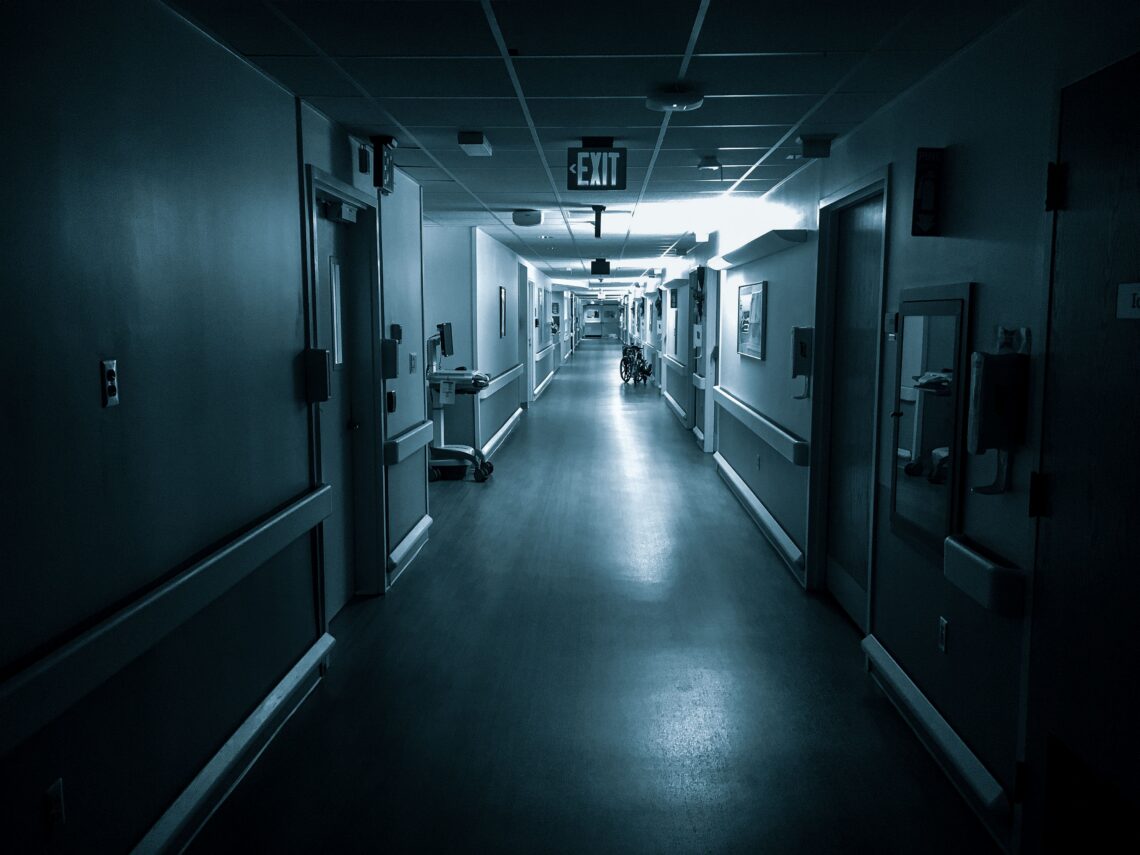
Photo by Sandy Torchon: https://www.pexels.com/photo/empty-long-corridor-of-modern-hospital-4094199/

